Tuesday, November 17, 2015

A New and Different Dhaka

It’s been a while since I’ve written in my blog. The truth is, circumstances of our life here in Dhaka have changed drastically and because of it, I felt that I didn’t have anything to say, but it just turns out that I have something different to write about.

I’ve already posted some thoughts on Facebook about this, but I still felt the need to put this somewhere more permanent. To show the people who aren’t here how resilient we can be.

Bangladesh is a predominantly Muslim country, but unlike what most Americans have come to believe, not all Muslims are the same. You wouldn’t condemn all Baptists because The Westborough Baptist Church exists would you?

I’ve written about my Muslim friends before and I stand by everything I have said. Bangladesh has enjoyed relative peace in their religion being more moderate Muslims. They have stayed off the radar so to speak but recently things have changed. ISIL has reared its ugly head and made a stand; first against the presence of western non-believers within Bangladesh’s borders and then against other Muslims who do not share their violent beliefs.

On September 28th an Italian was murdered in cold blood on the street walking home from the gym. A week later a Japanese man was killed several miles from Dhaka in the same manner. The choice of victims was apparently random. You know what the really bad thing about random killings is? Everyone is a target. ISIL claimed responsibility for the murders. If you are confused by the term ISIL vs. ISIS, don’t be. It’s all semantics and politics. They are one and the same.

ISIL upped their game a short time later when they bombed a Shiite Muslim celebration, killing a teenage boy and injuring at least 80 more people. Even other Muslims are not safe from ISIL’s attempt at domination, but I’m not here to argue politics. I’m here to tell you that terrorism has changed our lives.

For months I’ve been blissfully wandering the streets of Dhaka taking it all in. The colors, the noise, the crowds. I am energized by its chaos and while I know that Bangladesh has a lot of growing to do, I have come to love it. I reveled in hauling tubs of food through the slums to deliver to school children there. We explored the rivers and the countryside and I adopted this slightly broken country with an open heart.

Then with the pull of a trigger, life as we have known if ceased for embassy personnel and other expats around Dhaka. As surely as if each of us had been hit by those bullets, our freedom to explore our host country and lead normal lives died with the last breath of an Italian project manager named Cesare Tavella.

Embassies were forced to restrict the movements of those they are here to protect. Virtually every activity that I have loved has been taken away.

Embassy families are forced to stay indoors, rickshaws sit unused on the streets, the drivers losing money each day that expats are not allowed to roam the streets in anything but their vehicles.

There has been an evolution. The original restrictions were suffocatingly strict. In the beginning we were only allowed to travel to very limited locations and only by armored car. Eventually we could travel in our private vehicles but still only to limited locations. Restrictions have relaxed slightly as time has passed, but I am still banned from my beloved slum schools.

The reality exists.The face of terrorism is random and unruly. Everyone is a victim.

What matters now though, is the incredible strength that has been displayed by our community and that is what I cling to and revel in. In the face of sending children to school on buses with armed police, having others run our errands for us and asking local shop keepers to bring their wares to us, we have rallied to support each other. The ambassador and her staff have shown tremendous empathy while still having to make tough decisions in order to protect us.

The community liaison office has worked tirelessly to provide activities to bring us together and let us get outside of our own heads and our worries for a little while. We have developed a sense of community stronger than I have seen almost anywhere. 

I have seen our community rise above this as they open their homes to each other. The fun part is the creativity. Enticing stores to bring their goods with them, we have shopping parties. A local artist came and taught us paper mache art. We've had story time at the American Club. People are holding all kinds of interesting get togethers.


  Apartment buildings organized trick or treating within the building. People gather for game nights and movie nights. Anything to bring a sense of normality to our lives. Even the ambassador has joined in for many of the activities and her support has made a huge impact.

We don’t know what will happen next. We will continue to make life feel as normal as possible, but living under the constant threat of terrorism is not normal. We refer to where we are now as the “New Normal”.

My take away from all of this is that people are just cool. When faced with trials these people that I am proud to call friends have become their best selves and I am proud to be one of them.


Monday, September 21, 2015

A Daring and Dashing Diplomutt Dog

I’m back to talk about Chumleigh. International diplomutt and dog about town. The longer we live in Bangladesh the bigger his head gets. I think he always suspected he was extra special, even before we came here, but the residents of Dhaka only add fuel to the fire.

We had to stop taking Chumleigh for walks in our neighborhood. Because of the lack of any kind of animal control the Dhaka dogs have pretty much taken over the city and whenever they see Chumleigh coming, their ears perk up, their eyes brighten, they start to salivate and I can actually hear them thinking “How nice! She’s brought us a snack!”

Chumleigh's reaction to hearing that other dogs see him as a snack.

Because I neither wish to watch my dog become lunch, nor do I wish to throw myself into harm’s way to defend him, we have taken to driving down to the river once a week to give him a bit of exercise.

It’s become a nice little family outing. Every Saturday evening, we climb into the elevator, hit the ground floor button and as the doors slide open into the garage, Chumleigh emerges like a Middle Eastern prince making a grand entrance at a State dinner. The guards leap forward to greet him. You may not know it, but in Bangladesh, his name has about twelve syllables. Ch-ummmmm-a-leigh. Okay maybe only four, but you get the point.

He is greeted with enthusiasm. The guards and the grounds keeper scurry over to pet him and laugh at his antics. He preens and shows off, basking in the glow of his absolute certainty that this is the life he was born for all along. Jasim will have pulled the car up directly in front of the elevator. Upon our arrival he leaps out of the car and holds the door open…for Chumleigh. I have to open my own door. Chumleigh gives him a regal nod of his head, we pile into our car, and Jasim drives us about a mile to the edge of town. This takes about half an hour. No…really.


Once the car is in motion, it is our duty to roll the window down so that Chumleigh may address his subjects. He perches on Derek’s thigh to give him extra height and without fail every person we pass on the street rushes forward to catch a glimpse of him. I suspect it is mostly so they may speculate on what species he actually is. There is pointing. There is shouting. There is excessive attention. There is probably a betting pool.

Traffic never moves quickly in Dhaka so there is plenty of time for his subjects to view him. This means that our car is frequently surrounded. Small brown eyed children point and yell “Beral”! That’s Bangla for cat. I roll my eyes and yell back, “Beral Nai! (not a cat) Chowto Kukur (little dog)”. They look confused, shake their heads and decide that clearly I am drunk. He has also been mistaken for a monkey and yes, once even a bird.

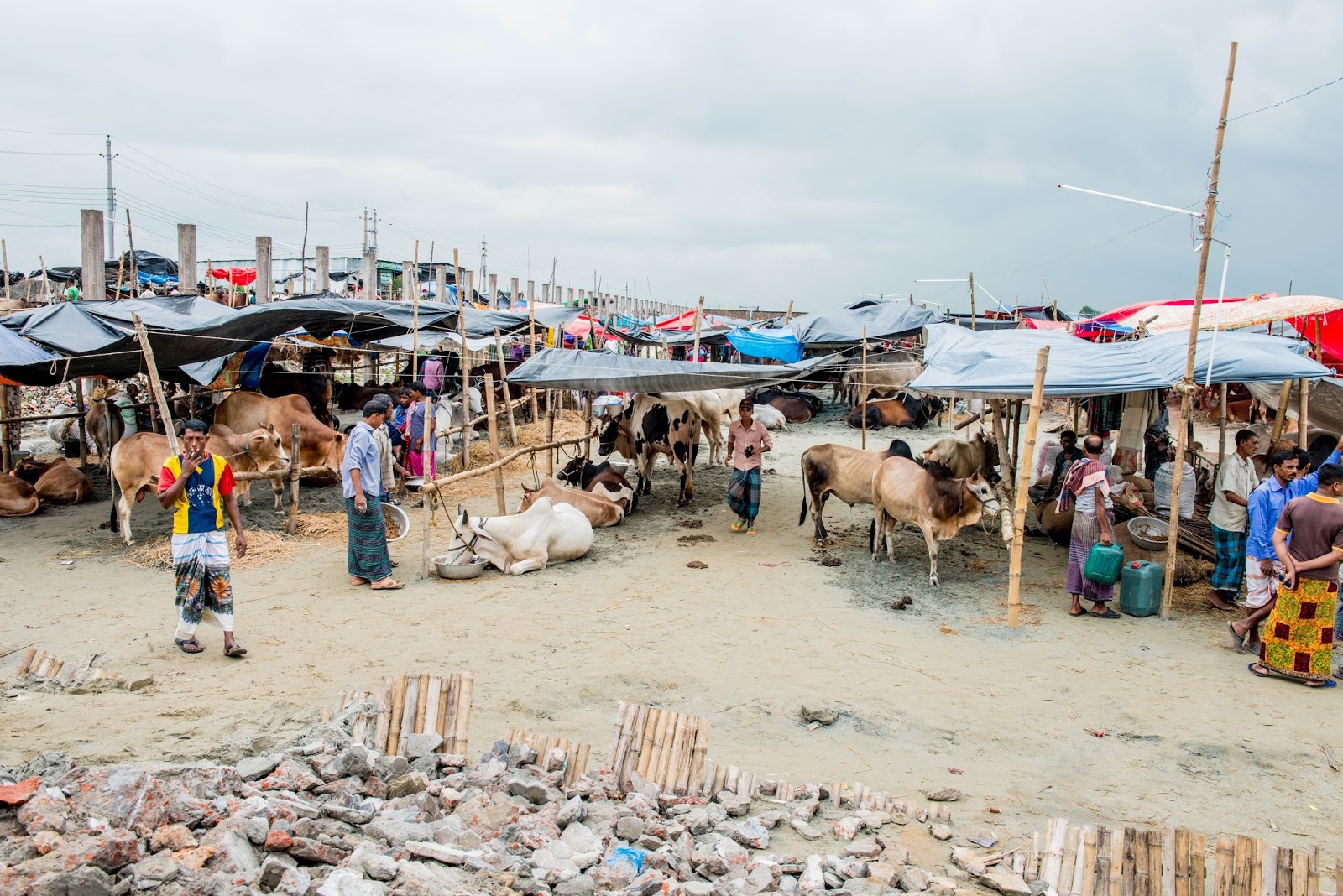
Yesterday, we once again piled into the car and headed to the river, only the landscape on the way to the dead end where we park had changed. Next week is Eid. Eid is the festival of sacrifice and thousands of cows, sheep and goats are brought into the city by meat merchants to sell. Then next week the animals will be sacrificed.

Where there had been only empty fields now there is a massive makeshift stockyards. I was fascinated by the spectacle and squealed at Jasim to stop so that I could take pictures. Derek announced that he would stay in the car with Chumleigh and I dashed away to explore. The locals were fascinated by the white lady hanging out in an Eid stockyard and were eager to show me the prize bull. A beast of an animal that Paul Bunyon would have fancied.


Once I finished taking pictures we headed back to the car and to my surprise, it was barely visible through the crowd. I was still trying to figure out why when Jasim belted out a laugh and yelled “Madam! They all must see Ch-ummmm-a-leigh”!

Sure enough a crowd surrounded the car at least four people deep on all sides pushing and craning their necks to be able to see Chumleigh, who was standing in the car window clearly thinking “Now THIS is how I should be treated”!


I climbed into the car, laughing my head off and snapped a few pictures of the crowd as they snapped pictures of us with their cell phones. Jasim pulled out, nearly running over people because they wouldn’t step back and we headed on to the river.


The crowds were much thicker than normal because of the holiday coming up. People lined the road all the way to the river.

As we parked the car and stepped out a little girl came running down the road yelling “Ch-ummmm-a-leigh!!!!” She followed us every step of our walk. Clearly we have been there too many times.


As we walked we continued to pick up more followers. It was starting to look like a parade. Each time Chumleigh stood up on his hind legs for attention his entourage went wild. People took pictures. Ma’am Chobi (picture)? Ma’am, selfie (yes. Selfie is universally understood)? The best part is, I love getting to visit with all his fans. They are warm and friendly and seem to appreciate it when we step into their world. They go wild when I try my Bangla on them. 


Eventually Chumleigh was spent. While he craves the attention, just like many celebrities, eventually he tires of it too. 


Amidst groans of disappointment from the crowd, we settled back into the car. He nestled down once again on Derek’s thigh, rested his chin against the window and breathed a sigh of either relief or satisfaction, I’m not sure which as he bade farewell to his throngs of followers, whom I am quite certainly, will be there waiting for him next week when we return.

Sunday, September 20, 2015

The Rickshaw Men


It’s been an incredible week filled with opportunities for renewed hope in the local community. From access to free dental and health care at the shine clinic to a beautiful event this morning designed to provide opportunities to improve local rickshaw driver’s income.

In an event sponsored by Mohammad Ziad Hafiz, a generous benefactor with Mountain of Mercy who funded the event and came all the way out from London to participate in presenting 51 Rickshaws were presented to deserving local residents.


Imagine that you are a man with little or no education. You have a wife and a couple of kids and each day you go to work long, grueling hours to support that family, but never seem to get ahead. You having a physically exhausting job. Then imagine having to give up nearly half of your very meager income each month to pay for the equipment you need to do your job.


This is the plight of thousands of rickshaw drivers on the streets of Dhaka. For many Bangladeshi men, a lack of education severely limits their job options. The most available job for many of these men is Rickshaw wala (drivers).


Here’s how the system usually works. These men can’t afford to buy their own rickshaw, so they rent from rickshaw ‘companies’. They generally pay between 3,000 and 5,000 tk a month to use the rickshaw. The average monthly income for pullers is 6,500-12,000tk a month depending largely on how able they are to work longer hours. The job is grueling. I have seen drivers with as many as four people on their rickshaw at a time. What these numbers mean is that even if someone is a dynamo and manages to make 12,000tk a month, in reality he is making more like 8,000 after paying rent on his rickshaw. Do the conversion and that comes to about $102.80 a month.


This is where Shine comes in. Thanks to the efforts of Daniel, Emma, Asma and Sadia to name a few, Rickshaw wala are getting the break of a lifetime. At Thrive we bump into these busy folks a lot. We are all working to a common goal; to make the lives of families in the basti a little better. While Thrives focus is to provide nutritious food to children and teach hygiene, Shine strives to not only educate the children of the slums but to help their families as well. The children we feed are often the children of these rickshaw drivers and other low paid families. 


Sadia Moyeen is on Thrives board of directors, but her philanthropic efforts don’t stop there. The Rickshaw project was designed to provide an opportunity for wala or “pullers” to become self-sufficient. Through an exhaustive vetting process, Daniel searches for honest men with a strong character. Men who take good care of their families and treat their wives well. He visits with family, friends and neighbors to ensure that the most deserving receive their help. 


Through donations and fund raising (mostly donations), The Rickshaw Project buys used rickshaws and gifts them to these deserving souls. Even their licensing fees are paid by the project. This eliminates the need to pay rent. It’s inspirational what happens to a beaten man when he is given his own life. A used rickshaw costs 10,000 taka. Easy for many of us, but unattainable to others. When a driver has his own rickshaw it creates a sense of pride of ownership, independence and a burning desire to work even harder because he is invested.

The organization has discovered that once the drivers own their own rickshaws, their income increases often by a few thousand taka a month, not counting the 3,000-5,000 they are able to keep rather than pay rent.


As of today’s event, they have provided over 120 rickshaw to local drivers.

I am always in awe of what I see being accomplished by these dedicated people. Sometimes the plight of the people of Dhaka can feel insurmountable. If you look at too broad a picture of this vibrant city its chaos can drown you but these individuals that I am privileged to call my friends have a gift for focusing in on one issue at a time and saying “I can fix that”. And then they do.


Today 51 men have been given a greater means to provide for their families and with each of these big hearted people’s endeavors, Dhaka becomes a little big better.


I wish I had the room to put pictures of each and every driver
receiving his picture. You should have seen the smiles!

On a side note, the next time you get in a rickshaw, remind yourself that the difference between 50 or 100 taka for a rickshaw ride is probably insignificant to you but a pretty big deal to your driver.